Keep going after an error.
Mistakes are part of learning. The product should let practice continue instead of treating an incorrect answer as a depleted resource.
Design Mentor started from a wish for a Mimo- or SoloLearn-like practice tool for designers. I shaped its progression from repeated comparisons toward a study, recall, detect, and reflect loop for practicing designers.
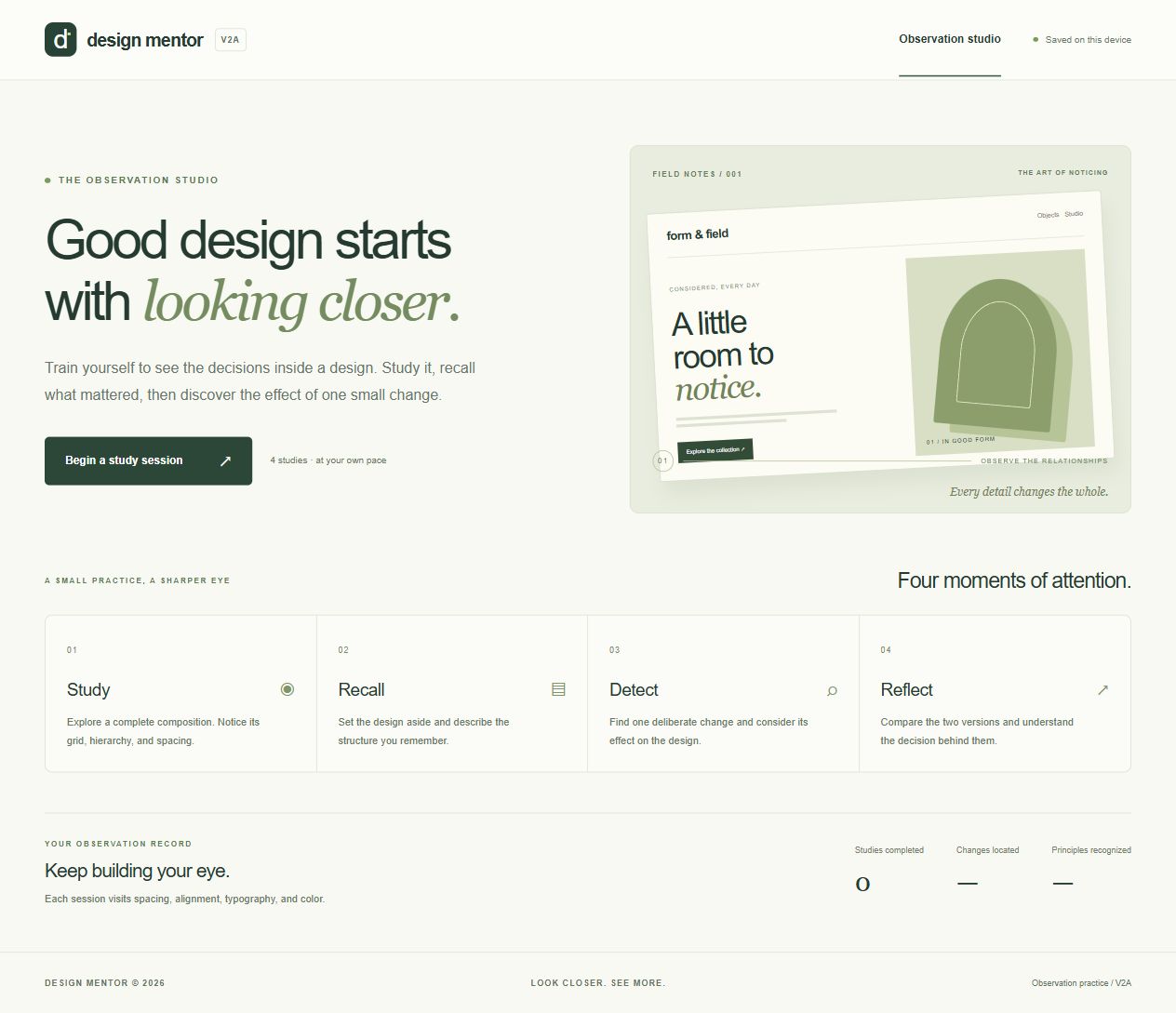
V2A’s observation studio establishes the four-part practice loop. This screenshot is a local working artifact, not evidence of learning outcomes.
I was drawn to the idea of an app like Mimo or SoloLearn for designers, but I did not want hearts or a mistake limit to turn errors into a reason to stop learning.
While working with Claude on the concept, I separated two skills I wanted to strengthen: noticing what is working or not working in a design, and making decisions I can explain.
Mistakes are part of learning. The product should let practice continue instead of treating an incorrect answer as a depleted resource.
This is my intended first audience. Specific work situations and success criteria still need discovery.
The study-and-change-detection direction came from wanting to strengthen the ability to point out a design’s strengths and weaknesses.
Early testing exposed that new words could still sit inside the same layout. I used those specific observations to steer the generator toward broader composition and mutation variety.
V1 used generated A/B comparisons across alignment, spacing, typography, and color, plus a timed placement flow and explanatory feedback.
I reported seeing the same layouts even when the text changed. That told me content variation and composition variation were not the same thing.
I asked for website snapshots, app screens, and typographic designs so the activity could feel closer to real design work than a collection of little cards.
I then noticed the same elements were being corrupted in predictable places. The direction expanded which element could change, where it could change, and how obvious the change could be.
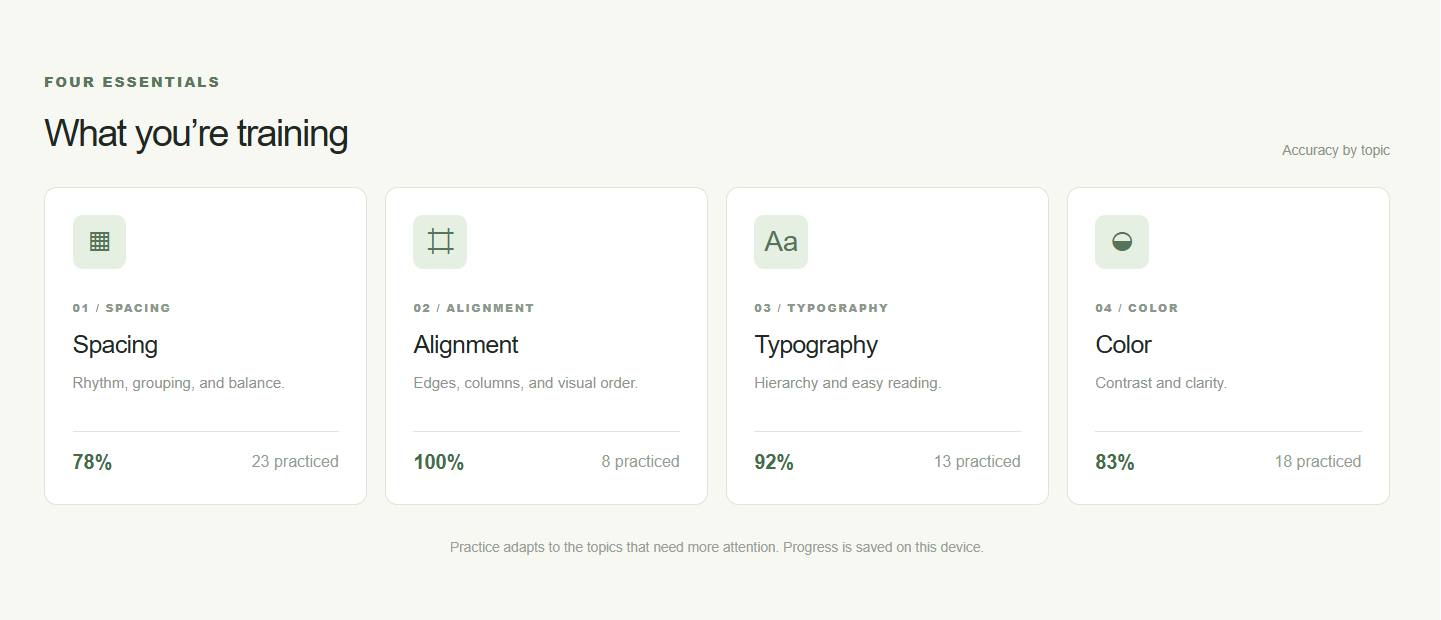
V2A turns the broader idea into a working local prototype. Each study asks the learner to inspect a composition, recall it while it is hidden, identify one controlled change, explain it, and review feedback.
The learner inspects one composition at their own pace before it disappears.
A written record preserves what the learner remembers; it is not automatically scored as prose.
Location and principle answers are scored separately, while the explanation remains available for reflection.
The current prototype is an implementation of the direction, not proof that the activity improves design judgment. I have not yet fully stress tested V2A.
I want to learn whether a person can move from noticing a design decision to making and defending one in an unfamiliar situation.
Record concrete tasks, awkward moments, and feedback from the people who have looked at V2A.
Test whether recall helps people notice structure and whether explaining a change leads to better diagnosis.
Explore construction, multiple flaws, richer diagnosis, and deeper concept adaptation only after the observation loop is understood.